Why Robotics Belongs in Every STEM Education
Robotics brings together science, technology, engineering, and math in a way no other subject can. Here is why it matters.
STEM without robotics is incomplete
STEM education (science, technology, engineering, and math) is widely recognized as essential for children. But most STEM programs teach these subjects in isolation. Math class is separate from science. Technology means using a computer. Engineering is abstract.
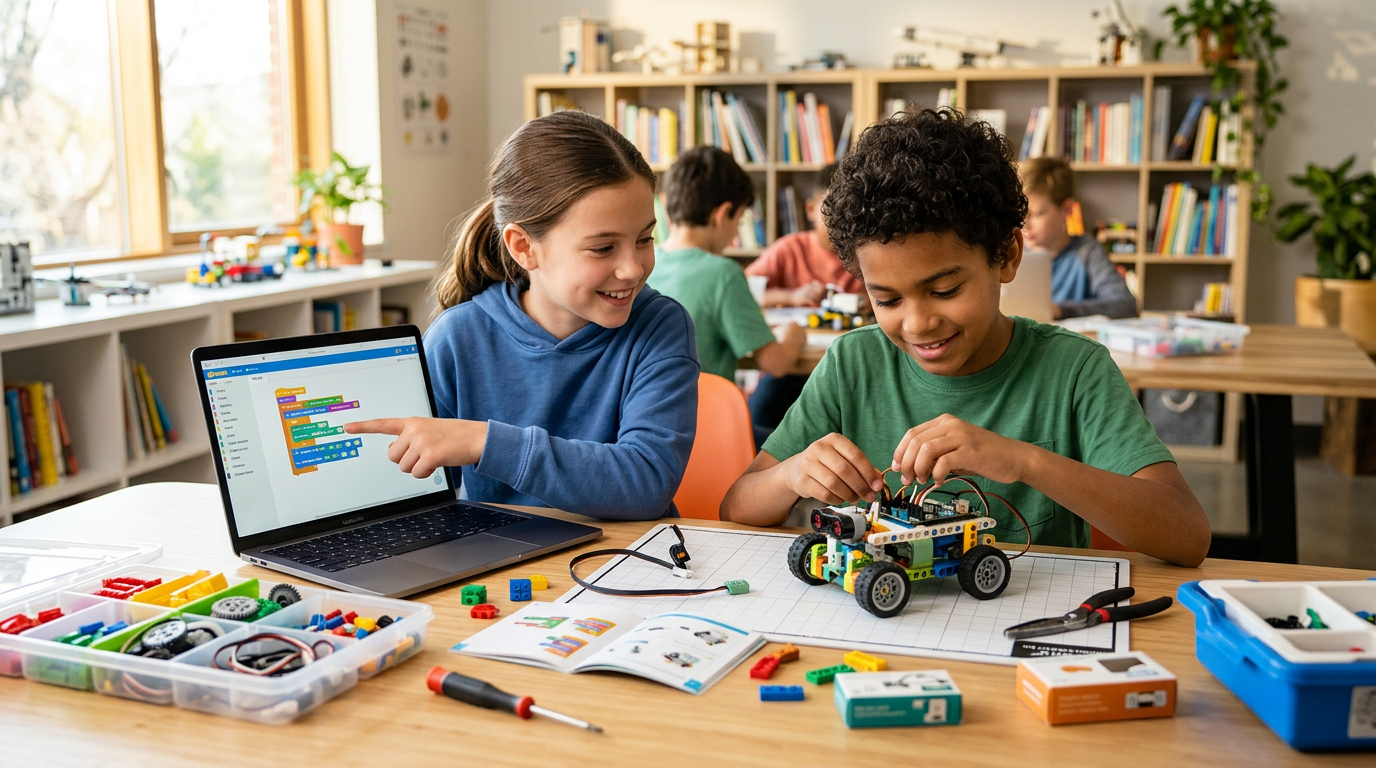
Robotics changes that. A single robotics project naturally combines all four disciplines: the physics of movement (science), the code that controls it (technology), the design of the system (engineering), and the calculations behind sensor readings and motor control (math). Nothing else integrates them this naturally.
The problem with theory-only STEM
Children learn best by doing. A worksheet about angles is one thing. Programming a robot to turn exactly 90 degrees, then watching it overshoot, then adjusting the code, is a completely different learning experience. The second version creates understanding that sticks.
Research consistently shows that hands-on, project-based learning produces deeper retention and stronger problem-solving skills than lecture-based or screen-only instruction. Robotics is project-based learning by definition.
What robotics teaches that textbooks cannot
- Debugging. When code does not work, the child must figure out why. This is the most valuable skill in all of technology, and it only develops through practice.
- Iteration. Build, test, fail, improve, repeat. This cycle is how every real engineering team works, and children internalize it naturally through robotics.
- Systems thinking. A robot is a system: sensors feed data to code, code makes decisions, decisions control motors. Understanding how parts connect is a skill that transfers to every complex problem.
- Presentation. When a child demonstrates their robot to their family, they practice explaining technical concepts in plain language, a skill that matters in every career.
Robotics makes math and science relevant
One of the biggest challenges in STEM education is the question children ask constantly: "When will I ever use this?" Robotics answers it immediately. You use angles to steer. You use variables to track speed. You use conditional logic to make decisions. Every abstract concept has a concrete, visible result.
Children who struggle with math in a classroom often thrive when the same concepts are applied to a robot they are building. The motivation shifts from "get the right answer" to "make my robot work," and that shift changes everything.
Starting early compounds over time
A child who begins robotics at age 8 or 9 builds a foundation of computational thinking that makes every subsequent STEM subject easier. By the time they reach high school physics, computer science, or engineering courses, the core concepts are already familiar. They are not learning from scratch. They are building on years of hands-on experience.
Ready to get your child started?
Every session is private 1-on-1 with a real AI expert. All equipment provided on-site.