Why Kids Should Learn AI Early
AI is reshaping every industry. Starting early gives your child a lasting advantage, and waiting is the real risk.
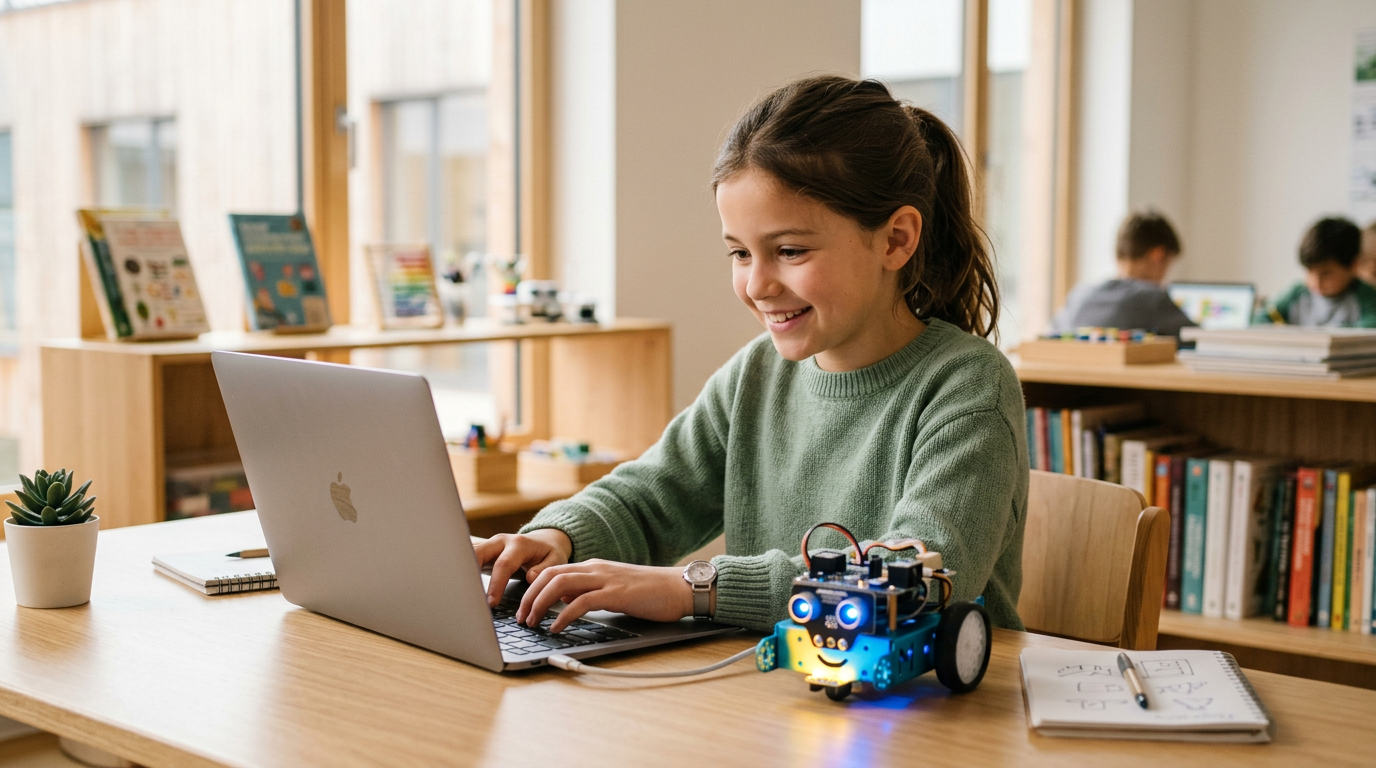
The world your child is growing into
By 2026, AI is already embedded in nearly everything: search engines, social media algorithms, medical diagnostics, self-driving vehicles, and even the tools teachers use in classrooms. This is not a future prediction. It is the present.
The children who understand how these systems work will have a fundamentally different relationship with technology than those who simply use it. One group will shape the tools. The other will be shaped by them.
Why early matters
Between ages 8 and 14, children develop their core approach to problem-solving. This is when they learn whether to accept things at face value or to ask how and why. Introducing AI concepts during this window does not mean teaching graduate-level math. It means building habits of thinking: recognizing patterns, questioning assumptions, and testing ideas through trial and error.
A child who trains a robot to navigate a maze by trial and error at age 10 is learning the same conceptual framework behind reinforcement learning, one of the most powerful ideas in modern AI. They do not need to know the term. They need to feel the process.
The real risk of waiting
A common concern from parents is that AI is "too advanced" for children. But the opposite is true. The longer a child only uses AI without understanding it, the harder it becomes to develop genuine technical intuition later. They build habits of consumption rather than creation.
Research from Stanford in 2026 showed that students who fully delegated coding to AI could produce working output but failed conceptual understanding tests afterward. For children with no existing expertise, this effect is even more pronounced. The AI's reasoning replaces the child's reasoning rather than competing with it.
What early AI learning actually looks like
For an 8-year-old, learning AI does not mean sitting in front of textbooks. It means building a robot that follows them around a room, programming it to avoid obstacles, and watching it respond to voice commands they created. It is physical, tangible, and genuinely exciting.
The technical understanding develops naturally through doing. After building five projects, a 10-year-old can explain the difference between a sensor reading and a decision, and that is the foundation of every AI system ever built.
What you can do now
You do not need to be technical yourself. You just need to give your child the opportunity to build, not just browse. Look for programs that use real hardware, offer private attention, and focus on understanding over memorization. The earlier your child starts thinking like a builder, the more naturally AI concepts will click as they grow.
Ready to get your child started?
Every session is private 1-on-1 with a real AI expert. All equipment provided on-site.