How AI Works: A Simple Guide for Families
A jargon-free explanation of how artificial intelligence actually works, written for parents and kids who want to understand the basics.
AI is not magic. It is pattern recognition.
At its core, artificial intelligence is software that finds patterns in data and uses those patterns to make decisions. That is it. There is no consciousness, no thinking, no understanding in the way humans experience it. AI is very good at one thing: processing enormous amounts of information and spotting relationships that humans might miss.
How a robot "learns"
Imagine you show a robot 100 photos of cats and 100 photos of dogs, each labelled. The AI examines every photo and finds patterns. Cats tend to have pointed ears, certain fur textures, specific face shapes. Dogs have different patterns. After training, when you show it a new photo, it compares what it sees against the patterns it learned and makes a prediction.
This is called machine learning. The robot was not "programmed" to recognize cats. It was given examples and it found the patterns itself. The quality of its predictions depends entirely on the quality and quantity of the examples it was given.
The three ingredients of every AI system
- Data. AI needs examples to learn from. More data, and more diverse data, generally produces better results. Bad data produces bad AI. This is why "garbage in, garbage out" is the most important rule in the field.
- A model. This is the mathematical structure that processes the data and finds patterns. Think of it as the "brain" of the system, except it is really just equations and statistics running very fast.
- Training. The process of feeding data through the model, checking if the predictions are correct, adjusting, and repeating, thousands or millions of times, until the model becomes accurate enough to be useful.
Why this matters for your family
When your child uses a voice assistant, recommendation algorithm, or AI image generator, all three of these ingredients are at work behind the scenes. A child who understands this, even at a basic level, interacts with technology more thoughtfully.
They start asking better questions: What data was this trained on? Could it be wrong? What would happen if I gave it different information? These are the questions that separate consumers from creators.
How kids experience this in practice
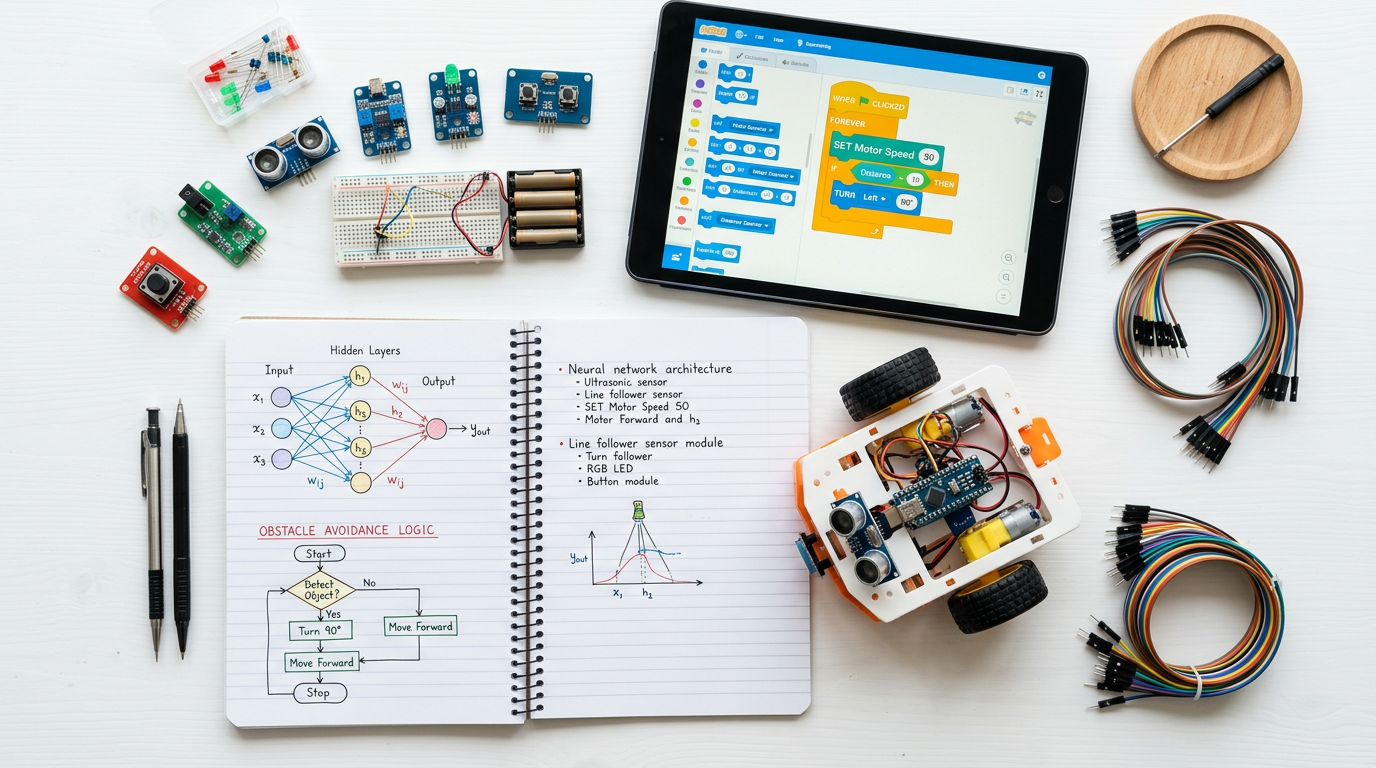
In a hands-on robotics program, children go through these exact steps with real hardware. They collect data (sensor readings, sound samples, images). They train a model (the robot "learns" to classify or respond). They test it, see it fail, improve the data, and try again. The entire AI pipeline, simplified and made tangible, happens in their hands.
By the end, they do not just know what AI is. They know how it works because they built one themselves.
Ready to get your child started?
Every session is private 1-on-1 with a real AI expert. All equipment provided on-site.